 Harborage elimination
Why Nest Removal Matters After the Rats Are Gone
Rat nests are not just the physical structure the colony builds -- they are heavily scent-marked territories. A roof rat colony's attic nesting site saturates the surrounding insulation with urine, glandular secretions, and pheromones that serve as homing signals. A Norway rat nest in a crawl space or wall void carries the same scent signature. If nesting material is left in place after the active colony is removed, it acts as an attractant -- new rodents from the surrounding population locate and re-occupy the site, often faster than the original colony established there.
Removing nesting material eliminates both the physical harborage and the chemical signal that makes the site attractive to future rodents. It is a meaningful step in making a completed removal durable, particularly in Huntsville's high-pressure rodent environment where the surrounding population is continuously active year-round.
Where Rat Nests Are Found in Huntsville Homes
Attic insulation layers
Roof rats shred fiberglass batt and blown insulation into dense nesting chambers in the deepest insulation layers, typically near the eaves or in corners where rafter meet the top plate. Nests may be 12-18 inches in diameter with multiple chambers in established colonies.
Crawl space soil and timber
Norway rat nests in crawl spaces are built in the protected corners where foundation walls meet floor joists, often incorporating paper, fabric scraps, insulation, and leaves pulled through the vent openings.
Wall voids near heat sources
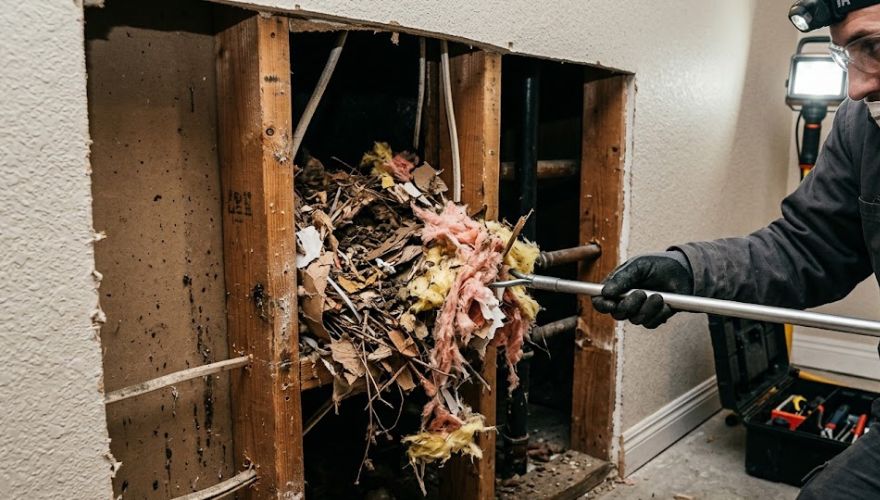
Both species build nests in wall voids adjacent to HVAC ducts, hot water pipes, and electrical panels -- locations that provide consistent warmth. These nests are hardest to access and may require limited wall opening to reach.
Behind and beneath appliances
House mice (and occasionally Norway rats) build nests in the thermal insulation of refrigerators, beneath dishwashers, and behind stove drawer cavities. These require appliance movement to access.
Garage storage areas
Cardboard boxes, stored fabric, and loose insulation in garages provide ready nesting material that Norway rats and mice consolidate into sheltered corners, particularly behind stored items against exterior walls.
Exterior debris piles
Woodpiles, leaf accumulations, and dense low ground cover adjacent to the foundation serve as exterior nesting sites that feed Norway rat pressure on the building perimeter.
Our Nest Removal Process
Nest Location and Documentation
During the inspection, we locate all active and recently abandoned nesting sites. Active nests -- warm, with fresh material or active rodents present -- indicate the removal phase is not yet complete. Abandoned nests from a completed removal cycle are ready for cleanup.
Disinfectant Pre-Treatment
All nesting material is pre-wet with disinfectant before disturbance to prevent aerosolization of pathogens in the nesting debris. Rat nests contain high concentrations of urine, droppings, and organic material -- aerosol exposure risk during disturbance is significant without pre-treatment.
Sealed Bag Removal and Disposal
Nesting material is removed by hand into sealed disposal bags using appropriate gloves and respiratory protection. Material is not swept or blown -- physical removal and containment only. Disposal follows applicable waste handling protocols.
Enzyme Sanitization of the Nesting Site
Once the material is removed, the vacated nesting area is treated with enzyme-based sanitization product to break down the scent markers left in the surrounding surface. This step is what reduces the attractant signal for future rodents at that site.
Frequently Asked Questions
Should I remove the rat nest myself?
Small, accessible nests in low-contamination situations can be removed with appropriate PPE -- rubber gloves, N95 respirator, and disinfectant pre-treatment. Large attic nests, crawl space nests, or nests in wall voids where access requires opening walls are better handled professionally.
Does nest removal need to happen before or after rat removal?
Ideally after the active population is eliminated. Disturbing an active nesting site while the colony is present typically causes the colony to relocate within the structure, complicating the removal phase. We assess whether the nest is active or abandoned during inspection.
Will rats come back to the same nest location?
Without scent-marker elimination (enzyme treatment of the nesting site), yes -- new rodents from the surrounding population are attracted to the same location reliably. Enzyme sanitization after removal is what breaks this cycle.
How long does rat nest removal take?
A single accessible attic or crawl space nest typically takes 45-90 minutes to remove and treat properly. Multiple nest sites or wall void access situations take longer. We assess scope during the inspection and quote accordingly.
Is the nesting material itself hazardous?
Rat nesting material is contaminated with urine, droppings, and potentially ectoparasites (fleas, mites) from the colony. It should be treated as a health-risk waste stream. We dispose of removed nesting material in sealed bags through appropriate channels.