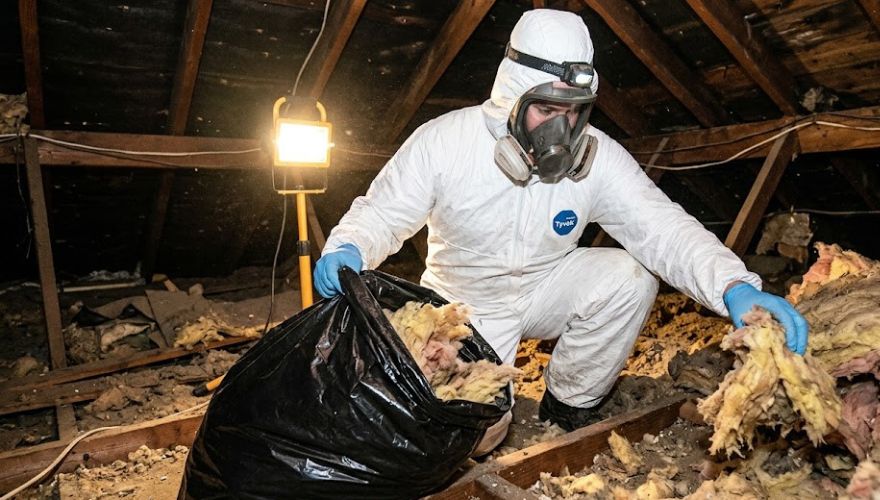
 After the rats are gone
What Roof Rat and Mouse Infestations Leave Behind in Huntsville Attics
Attic rodent cleanup addresses the contamination that accumulates over the full duration of an infestation -- not just what was present when the removal began. In Huntsville, where roof rat infestations in Twickenham and Blossomwood attics often go undetected for one to three months before the homeowner notices scratching, the volume of accumulated droppings, urine saturation of insulation, and nesting material can be substantial.
Roof rats traveling along attic rafter routes leave continuous grease smears and droppings deposits along their travel paths. Nesting colonies shred insulation into nesting chambers saturated with urine. House mice in attics produce proportionally smaller individual droppings but in extremely high density given their reproductive rate -- a colony of 30 mice in an attic produces hundreds of droppings per day across the insulation surface.
The health risk from accumulated attic contamination is primarily from disturbing the dried material during any attic access -- HVAC service, insulation work, or storage retrieval -- which aerosolizes dried rodent waste particles in a confined space. Professional cleanup eliminates this ongoing exposure risk and addresses the persistent urine odor that can migrate into living spaces below through ceiling penetrations and HVAC returns.
Attic Cleanup Process
Contamination Mapping
We document the extent of droppings deposition, nesting material location, urine saturation zones in insulation, and grease smear distribution across rafter routes. This mapping determines cleanup scope and whether insulation replacement is necessary in specific zones.
Disinfectant Pre-Treatment of All Affected Surfaces
EPA-registered disinfectant is applied to all droppings-affected surfaces, nesting material, and insulation zones showing urine saturation before any physical disturbance. Contact time is observed before removal begins.
HEPA-Filtered Droppings Removal
Droppings are removed from all accessible attic surfaces -- rafter plates, top plates, structural members, and accessible insulation surfaces -- using HEPA-filtered equipment. Nesting material is removed in sealed bags. Standard vacuum cleaners are not used.
Enzyme Sanitization Treatment
Enzyme-based sanitization is applied to all contaminated structural surfaces and the accessible insulation surface. Enzyme treatment breaks down urine proteins, eliminates the scent markers that attract new rodents to previously occupied attic spaces, and reduces persistent odor.
Deodorization
Thermal fogging or spray-based deodorization treatment addresses residual attic odor in the air space. This step is particularly important when urine saturation of insulation has been extensive and odor is migrating into living spaces.
When Insulation Replacement Is Also Needed
Attic cleanup removes droppings from insulation surfaces and enzyme-treats the accessible layer. When insulation has been heavily saturated with urine throughout its depth -- not just surface contamination -- or when nesting material has destroyed the insulation structure in sections, full insulation removal and replacement is the appropriate remediation. We assess insulation condition during the cleanup scope review and quote insulation replacement separately if it is warranted. See our insulation replacement service for details.
Frequently Asked Questions
Do I need attic cleanup even if the rats are gone?
Yes. The health risk from accumulated attic droppings and urine contamination persists after the rodents are removed -- any attic access disturbs the dried material. Enzyme treatment also eliminates the scent markers that attract new rodents to the same attic space, which is critical for maintaining the removal result.
Can I do attic cleanup myself?
Spot cleanup of small, accessible areas with appropriate PPE (N95 respirator, gloves, disinfectant pre-treatment) is manageable. Significant attic contamination covering multiple rafter bays or involving nesting sites requires HEPA equipment and enzyme treatment that isn't practical with consumer-grade tools.
How long does attic cleanup take?
A standard single-story attic with contained infestation typically takes 3-6 hours. Larger attics, two-story homes with complex attic layouts, or severe contamination may require a full day. We quote time and scope after the contamination assessment.
Will attic cleanup eliminate the odor completely?
Enzyme treatment addresses urine proteins and significantly reduces odor. Complete odor elimination depends on the depth of urine saturation in the insulation. If insulation is heavily saturated throughout and not replaced, some residual odor may persist. We assess insulation saturation during cleanup and advise on whether replacement is warranted for full odor resolution.
Should cleanup happen before or after exclusion work?
Cleanup can happen concurrently with or after exclusion work. We typically complete the exclusion sealing first on the same visit (or an immediately following visit), then perform the cleanup. Doing cleanup before exclusion risks re-contamination if any entry points remain open.