 When cleanup isn't enough
When Rodent-Damaged Insulation Needs Replacement, Not Just Cleanup
Attic and crawl space insulation cleanup -- HEPA removal of surface droppings and enzyme sanitization -- addresses surface contamination effectively when urine saturation is limited to the upper insulation layer. But in Huntsville roof rat and Norway rat infestations that went unaddressed for multiple months, urine soaks through the full insulation depth. Enzyme treatment applied to the surface cannot fully penetrate to break down urine proteins at the base of a deeply saturated insulation batt. Odor persists, and the health hazard remains embedded in the material.
Similarly, roof rat colonies that establish nesting chambers within attic insulation -- shredding fiberglass batt into dense nesting masses -- destroy the insulation structure in those zones. R-value in the affected sections drops to near zero, and the void is a continuing harborage attractor. Enzyme-treating a destroyed nest chamber doesn't restore insulation performance or eliminate the harborage signal.
Insulation replacement is warranted when: urine saturation is detected throughout the full depth of the insulation layer; more than 20-25% of the attic floor is covered by destroyed or heavily compressed nesting areas; or a post-cleanup odor assessment indicates persistent off-gassing from the remaining material.
Our Insulation Replacement Process
Rodent Removal and Exclusion First
Insulation replacement is always the last step -- after the active population is eliminated and entry points are sealed. Replacing insulation before exclusion creates a fresh substrate for an active colony to contaminate again. We confirm removal and exclusion are complete before beginning insulation work.
Contamination Assessment and Scope Definition
We assess which sections of the attic or crawl space insulation require full removal versus targeted replacement of the most heavily damaged zones. Not every infestation requires whole-attic replacement -- we scope the work to what's actually warranted.
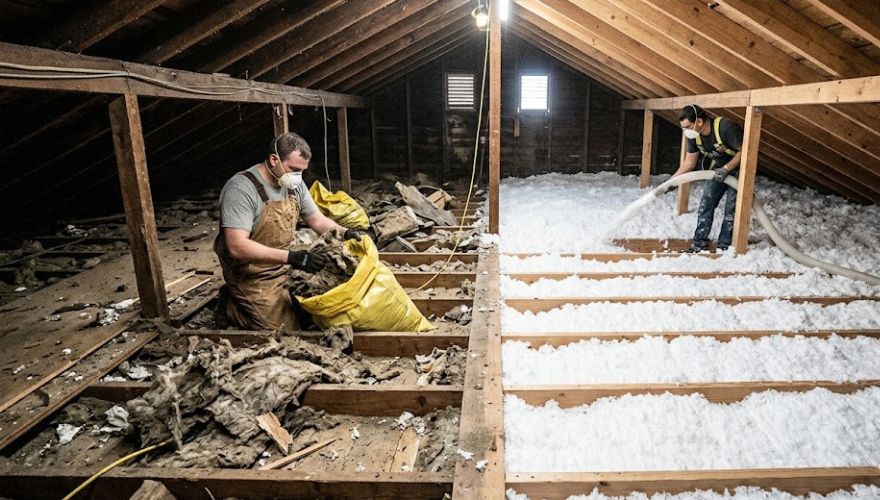
Contaminated Insulation Removal
Old insulation is removed using HEPA-filtered equipment, bagged in sealed bags, and disposed of through appropriate channels. Existing structural surfaces are cleaned and sanitized before new insulation is installed.
Structural Surface Enzyme Treatment
After insulation removal, all structural attic surfaces -- rafters, top plates, sheathing -- are enzyme-treated to eliminate residual urine and scent markers before new insulation is installed. This step is critical for long-term odor elimination and for reducing harborage attractant signals.
New Insulation Installation
New insulation is installed to current code requirements for Huntsville's climate zone -- typically R-38 to R-49 for attic spaces. Insulation type (blown-in cellulose or fiberglass, batt) is selected based on attic configuration and your preference. Crawl space insulation replacement follows appropriate below-grade specifications.
Frequently Asked Questions
How do I know if my insulation needs replacement rather than just cleanup?
Key indicators are persistent urine odor after a cleanup treatment (indicates saturation beyond the surface layer), visible large nesting chambers that have destroyed insulation structure, urine staining visible throughout the full insulation depth when it is disturbed, and a prior infestation that went undetected for more than 2-3 months.
Does homeowner's insurance cover rodent insulation replacement?
Coverage varies significantly by policy. Some policies cover accidental rodent damage as part of sudden and accidental coverage; others explicitly exclude pest damage. We provide detailed written documentation of the damage extent and scope of work that you can submit with an insurance claim if your policy may provide coverage. We don't make coverage determinations -- that's between you and your insurer.
What type of insulation do you install?
We install blown-in fiberglass or cellulose insulation for attic spaces, and appropriate batt or rigid insulation for crawl space applications. Blown-in is generally preferred for attic replacement after rodent damage because it achieves consistent coverage without gaps that rodents can re-exploit. We discuss the options during the assessment.
Should I get insulation replacement or just cleanup?
We assess this during the contamination review and give you an honest recommendation. Not every infestation requires full replacement -- if urine saturation is limited to the upper layer and the insulation structure is intact, thorough cleanup and enzyme treatment is sufficient. We don't recommend replacement when cleanup is adequate.
How much does insulation replacement cost?
Typical costs range from $800 for a smaller attic with targeted replacement to $3,500 or more for full whole-attic replacement on a larger Huntsville home. Crawl space insulation is quoted separately. We provide a written quote after the contamination assessment.