 The Huntsville canopy problem
Why Roof Rats Are Huntsville's Most Common Attic Pest
Huntsville's mature hardwood canopy is one of the city's defining landscape features — the sweeping tree coverage across Twickenham, Blossomwood, and the Monte Sano foothills is part of what makes these neighborhoods visually distinct. It's also an unbroken highway for roof rats.
Rattus rattus evolved in arboreal environments. They are exceptional climbers — capable of scaling vertical brick, traversing utility lines, and crossing tree limbs with the grip and balance of a squirrel. A mature oak with branches within 4–6 feet of a roofline provides direct access to attic vents, fascia gaps, and open soffits. The rat doesn't need to find a ground-level entry; it finds the roofline entry instead, which most homeowners never think to inspect.
Huntsville's year-round subtropical climate means roof rats breed continuously. There's no cold-season die-off. An attic that's colonized in October will have an established, multi-generational population by the following spring if left untreated. The insulation degradation, gnaw damage, and contamination that accumulates in that time is one of the more expensive remediation scenarios we encounter.
The Burritt on the Mountain ridgeline, the neighborhood topology around Big Spring Park, and the wooded corridors along Monte Sano State Park all sustain large wild roof rat populations that continuously repressure the surrounding residential areas. Exclusion — sealing the roofline — is not optional for long-term results in these neighborhoods.
Roof Rat vs. Norway Rat — Why the Distinction Matters
Roof rats and Norway rats share similar taxonomy but behave differently enough that treating one infestation with the other species' approach is reliably ineffective. Norway rats burrow at ground level and travel along floor-level runways — overhead trap placement accomplishes almost nothing against them. Roof rats travel overhead, nest in attics and wall voids near the roofline, and rarely descend to floor level.
A technician who misidentifies the species and places all ground-level trap stations for a roof rat infestation will catch zero animals and conclude the infestation has resolved when it hasn't. Species-specific identification drives species-specific treatment — which is why our inspection always precedes any placement.
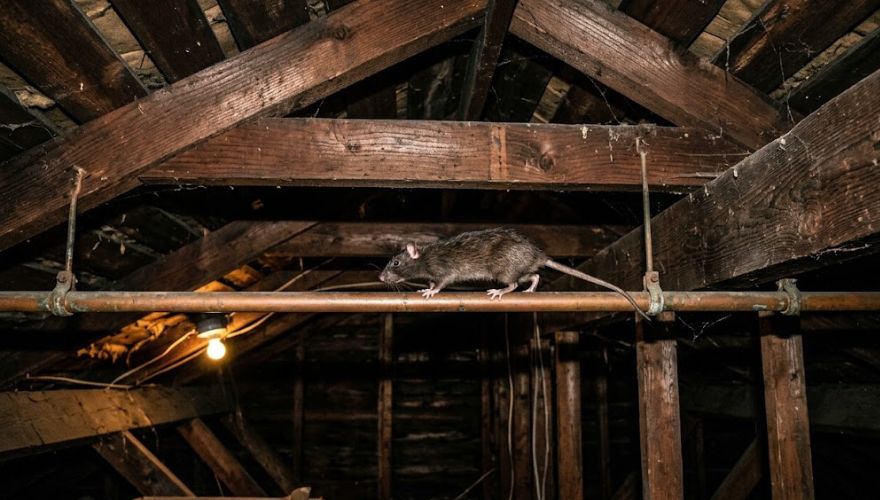
Identifying roof rats: slender body (6–8"), pointed nose, tail consistently longer than the body, often gray-brown to black coat. They leave grease marks on overhead surfaces — rafters, top plates, attic beams — rather than along floor baseboards. Droppings are spindle-shaped, smaller than Norway rat droppings, and concentrated along attic travel routes.
Our Roof Rat Removal Process
-
Roofline & Attic Inspection
We inspect the full roofline from outside — fascia board condition, soffit integrity, ventilation screen condition, plumbing stack openings, and any tree limb contact points within 10 feet. Attic inspection covers active runway grease marks, droppings concentration zones, nesting material location, and all interior-accessible entry gaps. We document everything before quoting.
-
Tree & Utility Line Assessment
We identify all overhead access pathways — tree limbs within 6 feet of the roofline, utility lines running to exterior wall attachment points, trellises or vines on exterior walls. We note which require trimming or management as prevention steps, and which are structural issues requiring hardware correction.
-
Attic Trap Placement
We place snap traps along confirmed overhead runways — at wall top plates, along rafters near identified droppings concentrations, and at interior entry points. Roof rats are trap-shy at first; placement timing and location relative to runway evidence is more important than trap quantity. We place accordingly and return to clear and assess.
-
Roofline Exclusion
Once the active population clears, we seal roofline entry points: stainless steel mesh over open soffits, hardware cloth at fascia gaps and plumbing penetrations, ventilation screen repair or replacement, and caulk backing at smaller fascia-to-roofing junctions. Roofline work is done from extension ladder or roof access as appropriate for the property.
-
Prevention Guidance
We provide written notes on tree limb clearances, utility line management options, and any secondary entry points that fall outside our exclusion scope for the current job. This gives homeowners a complete picture of what maintains the result long-term.
High-Risk Huntsville Neighborhoods for Roof Rats
Roof rat pressure in Huntsville correlates directly with canopy density and housing age. These neighborhoods see our highest volume of roof rat calls:
Twickenham
19th-century homes with original fascia construction and adjacent mature oak canopy. Highest historic district roof rat density in Huntsville.
Blossomwood
Dense residential canopy, post-WWII construction with aging soffit systems. Consistent roof rat pressure year-round.
Five Points
Mixed commercial/residential, mature street trees, older mixed-vintage housing stock. Continuous overhead rat travel corridor.
Monte Sano
Mountain-adjacent with proximity to Monte Sano State Park's wild population. Elevated canopy-to-roofline pressure on ridgeline properties.
Mountain Gap
Wooded lots, older construction, tree canopy frequently in contact with rooflines. High seasonal pressure in autumn canopy-drop period.
Jones Valley
Valley topography with mature riparian hardwoods. Norway and roof rat pressure both elevated; species-specific ID is essential.
What Roof Rats Do to Huntsville Attics
Roof rats nest in attic insulation, shredding fiberglass batts and blown insulation to create dense nesting chambers. A mature colony generates significant contamination — urine saturates insulation continuously, and droppings accumulate in nesting areas and along travel routes. Beyond the sanitation concern, degraded insulation loses R-value over time, resulting in measurable heating and cooling efficiency loss in Huntsville's climate extremes.
Gnaw damage from roof rats targets softer materials within the attic — foam insulation boards, plastic vapor barrier, and critically, electrical wiring. Plastic insulation on cables is preferred gnawing material. Bare wiring in an attic space is a fire risk that insurance companies increasingly scrutinize at claim time.
Full attic cleanup and sanitization after roof rat infestation is addressed under our attic cleanup service. Insulation replacement is covered under insulation replacement. Both can be quoted as part of comprehensive roof rat remediation.
Frequently Asked Questions
How do roof rats get into Huntsville homes?
Roof rats climb tree limbs touching eaves, utility lines running to the home, and ivy or vines on exterior walls. From the roofline they enter through open soffits, damaged fascia boards, plumbing vents, roofline gaps, and deteriorated attic ventilation screens. Most entry points are 1½–2" or smaller.
Which Huntsville neighborhoods have the worst roof rat problems?
Neighborhoods with heavy mature hardwood canopy see the highest pressure: Twickenham, Blossomwood, Five Points, Monte Sano, Mountain Gap, and Jones Valley. Properties where tree limbs grow within 6 feet of the roofline are the most vulnerable regardless of neighborhood.
Are roof rats the same as black rats?
Yes. Roof rats (Rattus rattus) are also called black rats or ship rats. In Huntsville they range from gray-brown to dark brown and are identified by their slender build, pointed nose, and tail that is longer than the body — unlike the Norway rat's shorter tail.
How much does roof rat removal cost in Huntsville?
Roof rat removal typically ranges from $350 to $1,600 depending on attic access difficulty, colony size, extent of roofline exclusion work needed, and whether insulation cleanup is included. We provide a written quote after the free inspection.
Do I need to trim my trees to prevent roof rats?
Maintaining at least 6 feet of clearance between tree limbs and your roofline is one of the most effective prevention steps. Roof rats won't easily jump more than 4–6 feet horizontally, so removing direct contact points significantly reduces entry pressure. We note specific limb clearance needs during our inspection.