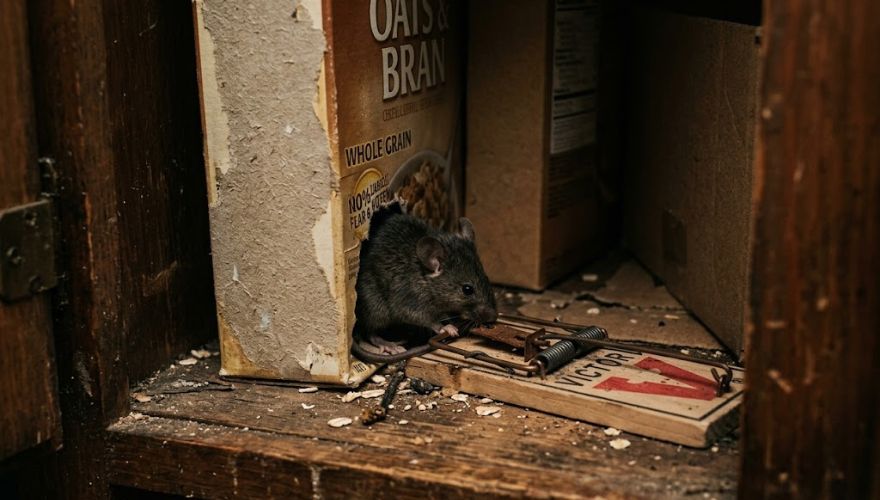
 The house mouse problem in Huntsville
Why House Mice Are the Most Widespread Rodent in Huntsville Homes
The house mouse is the most broadly distributed rodent in Huntsville — found in virtually every neighborhood from Twickenham's antebellum-era homes to the newest subdivisions in Hampton Cove and Brownsboro Road. Unlike Norway rats (which cluster in older, ground-level structures near food infrastructure) or roof rats (which concentrate where mature hardwood canopy provides overhead access), house mice can colonize any building with a gap larger than a quarter inch and a food source within reach.
Huntsville's housing diversity makes this worse. The Tennessee Valley's construction eras span from 19th-century Twickenham homes with original foundation framing, through mid-century ranch houses across South Huntsville and Merrimack, to 2020s new construction in Providence and Redstone Gateway-adjacent developments. Each era has its own characteristic gap profile — and house mice exploit all of them.
Huntsville's humid subtropical climate is also a key factor. In northern states, cold winters thin house mouse populations naturally. In Huntsville, breeding runs all twelve months — a pair that enters in October becomes a colony of 30 to 50 animals by February without intervention. That exponential timeline is what makes prompt treatment critical.
Key fact: A house mouse can compress its body to fit through any gap larger than ¼ inch — roughly the diameter of a standard pencil. This is smaller than most homeowners assume, and it means the entry point causing your infestation may not be visible without a systematic exterior inspection.
Signs of House Mice in Your Huntsville Home
Small, rice-sized droppings
House mouse droppings are 3–6mm, rod-shaped, and pointed at both ends. They concentrate near nesting areas, food sources, and along travel runways — typically at countertop level, inside cabinets, or in attic corners. Volume tells you population size: a few droppings means a small incursion; dozens per day means an established colony.
Nighttime scratching sounds
House mice are nocturnal and most active in the hours after midnight. Scratching, rustling, or scurrying in walls, above ceilings, or inside cabinets at night is the most common first sign Huntsville homeowners notice — often before finding droppings.
Gnaw marks on food packaging
Mice chew through cardboard, thin plastic, and foil packaging. Gnaw holes in cereal boxes, dog food bags, or pantry containers indicate mice have accessed food storage areas. These are also health contamination points — any packaging a mouse has contacted should be discarded.
Musky odor
A persistent musky or ammonia-like smell in a closed space — inside a cabinet, in an attic corner, in a crawl space — often indicates an established mouse colony nearby. The smell is from accumulated urine, which mice use to mark territory and communicate. Heavy odor indicates a large, established infestation.
Nesting material
Shredded insulation, fabric, paper, or plant material gathered into a palm-sized loose pile. Common nesting locations in Huntsville homes include inside insulation batts in attics, behind appliances in kitchens, inside wall cavities near heat sources, and in stored boxes in garages and basements.
Pets behaving unusually
Dogs and cats often detect mouse presence before humans do. A pet repeatedly investigating a wall, cabinet base, or appliance side — or a cat that has suddenly resumed "hunting" behavior in a previously calm area — frequently indicates a mouse runway or nesting site behind the surface.
Common House Mouse Entry Points in Huntsville Properties
Effective mice control starts with entry-point identification. The most common routes we find in Huntsville homes and commercial properties:
- Garage door perimeter gaps: The seal at the bottom and sides of attached garage doors deteriorates over time. Even a ½-inch gap is a viable mouse entry. Garage-connected utility areas and kitchens are frequently the first areas where mice appear.
- Weep holes in brick veneer: Many Huntsville homes built from the 1970s onward use brick veneer with open weep holes at the base — code-required for moisture drainage, but also a standard mouse entry. Weep hole covers that exclude mice while maintaining airflow are available and effective.
- Utility pipe penetrations: Gas lines, plumbing, and HVAC connections that pass through exterior walls often have gaps around them where original caulk has aged or shrunk. These penetrations at wall base level are primary Norway rat entry points; those at mid-wall or above serve house mice.
- Foundation sill plate gaps: Older Huntsville homes — particularly pre-1960 construction in Twickenham, Merrimack, and Lincoln Village — often have gaps between the foundation and the wooden sill plate where settling has created openings. These ground-level gaps serve both mice and Norway rats.
- HVAC condenser line penetrations: The refrigerant and condensate lines that exit through exterior walls for central air systems (common across all Huntsville housing) frequently have oversized holes with gaps around the lines. These mid-wall penetrations are ideal mouse entry points.
- Roof and soffit transitions: Gaps at the junction of roofing material and fascia boards, or deteriorating soffit boards, allow house mice to enter attic spaces. In Huntsville's hot-humid climate, wood in these locations is particularly susceptible to moisture-driven degradation that creates gaps over time.
Our Mice Control Process
- 1
Free property inspection
Interior and exterior walk documenting droppings locations, runways, entry points, nesting sites, and food source exposure. The exterior inspection is as important as the interior — entry point identification drives the exclusion plan.
- 2
Population assessment
Dropping count, runway activity, and sound profile help us gauge infestation size, which determines the density and type of removal approach recommended.
- 3
Targeted removal
Snap traps placed precisely on active runways — the locations mice travel repeatedly. Placement along walls with the trigger perpendicular to the travel path maximizes capture rate. We don't guess at locations; we place at confirmed runways identified in the inspection.
- 4
Entry point exclusion
Every identified entry point sealed with appropriate material — steel wool and caulk for smaller gaps, hardware cloth for vented areas, and expanding foam plus mesh for larger penetrations. Materials are matched to location and exposure.
- 5
Sanitation and prevention guidance
Advice on food storage, outdoor attractants (bird feeders, compost, accessible garbage), landscaping proximity to the foundation, and any attic or crawl-space cleanup needed after the infestation is resolved.
Locally Owned. Mon–Sat 7AM–10PM. Call Today.
Free inspection for house mouse activity across Huntsville and Madison County. Same-day availability most days.
📞 Call (844) 635-0403Mouse Control Across Huntsville Neighborhoods
House mice don't discriminate by neighborhood — they appear everywhere from Twickenham's historic homes to Providence's newest subdivisions. But the specific entry routes and nesting patterns do vary by construction era and housing type.
In older residential areas like Merrimack, Lincoln Village, and Terry Heights, foundation-level sill plate gaps and deteriorating crawl-space vent screens are the primary entry routes. These mid-century properties were often built with materials that have since degraded, creating gap profiles that require systematic inspection to document.
In newer suburban developments including Rolling Hills, Sherwood Park, and Lake Forest, weep holes and HVAC penetrations are the dominant entry points. These properties are often better-sealed at the foundation but have more mid-wall and upper-wall penetrations from utility installations.
Multi-unit residential properties across MidCity and downtown Huntsville face shared-wall transmission — where mice move between units through gaps in plumbing chases and electrical conduit runs. Property management programs for apartment buildings require a different treatment structure than single-family residential work. See our apartment and property management rodent control service for multi-unit properties.
Related Services
- Mouse Infestation Treatment
- Mouse Proofing
- Exclusion Services
- Crawl Space Sealing
- Attic Proofing
- Droppings Cleanup
- Residential Control
- Apartment / Property Mgmt
Frequently Asked Questions — Mice Control in Huntsville
How do house mice get into Huntsville homes?
House mice can compress through gaps as small as ¼ inch — the diameter of a pencil. In Huntsville, the most common entry routes are weep holes in brick veneer, gaps around HVAC line penetrations, deteriorating garage door seals, and aging sill plate gaps in older homes. Entry-point inspection is the essential first step in any effective mouse control program.
How many mice are usually in a Huntsville infestation?
A single breeding pair produces 5 to 10 litters per year with 5 to 6 pups per litter. In Huntsville's year-round mild climate, a small fall incursion can grow to 30 to 50 animals by mid-winter. The sooner you address mouse activity, the smaller the scope of treatment required.
Are mice in Huntsville a health risk?
Yes. House mice are vectors for hantavirus, salmonella, and leptospirosis. Their droppings, urine, and nesting material contaminate food-prep surfaces and air quality, particularly in confined spaces like attics and pantries. Droppings cleanup and surface sanitization are part of a complete mouse control response.
Can I handle mice myself in Huntsville?
DIY snap traps can reduce visible activity, but without entry-point sealing, new mice continuously replace removed animals. Most Huntsville homeowners who call us have already tried store-bought traps. Professional inspection identifies every entry point — including the non-obvious ones — and provides the complete solution.
How much does mouse removal cost in Huntsville?
Most house mouse jobs in Huntsville range from $250 to $900 depending on property size, entry-point count, and exclusion scope. Larger infestations with attic nesting and significant droppings cleanup add to the total. We provide a written quote after the free inspection.