 The quarter-inch gap problem
Why Mouse Proofing Requires a Full-Property Sweep
A house mouse can squeeze through any gap a quarter inch or larger -- roughly the diameter of a pencil eraser. At this scale, a typical Huntsville home has 20-60 potential entry points: garage door weather stripping corners, foundation weep holes in brick construction, utility penetration gaps, deteriorated door sweep edges, dryer vent dampers that do not fully close, gaps at sill plate junctions where framing meets foundation, and gaps in vinyl siding panels that have cracked or separated over Huntsville's temperature cycles.
Sealing three obvious gaps while leaving fifty others open does not reduce mouse entry -- it slightly inconveniences them before they find the next opening. Complete mouse proofing requires finding and sealing every significant gap around the property exterior.
Common Huntsville Mouse Entry Points
Garage door corners
Weather stripping deterioration at door side corners leaves consistent gaps -- among the most used mouse entry points in Huntsville suburban homes.
Brick weep holes
Weep holes are intentional drainage openings typically 3/8 inch wide -- exactly mouse-sized. Open weep holes along foundation courses are a primary entry in older Huntsville construction.
HVAC and plumbing lines
Gaps around where mechanical lines enter through exterior walls are present in virtually every Huntsville home -- often not sealed during original construction.
Door sweeps
Worn or absent door sweeps on exterior, garage, and utility room doors create ground-level gaps along the full door width that mice travel through routinely.
Dryer and HVAC vents
Vent terminations without functional flap dampers provide direct interior access where duct terminates at exterior wall -- common in older Huntsville homes.
Siding and trim gaps
Cracked or separated vinyl siding, wood trim gaps at window and door frames, and soffit panel joints in older construction all provide mouse-sized openings.
Mouse Proofing Materials
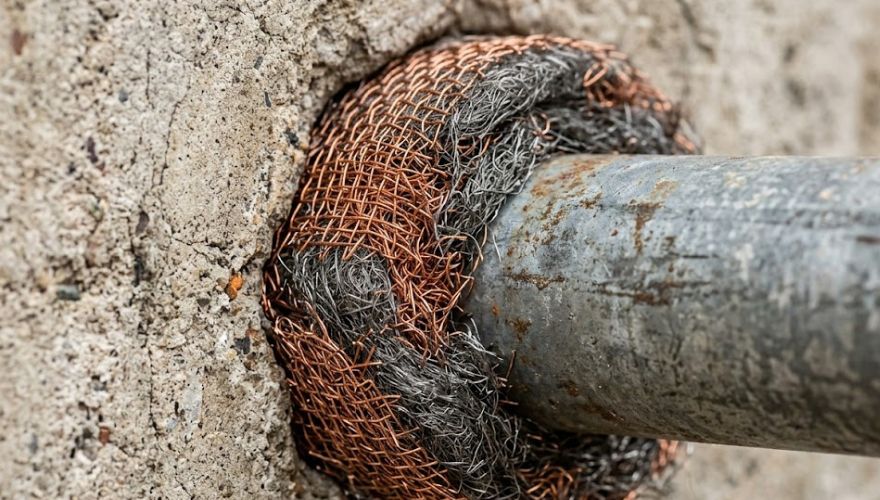
For gaps a quarter to a half inch, steel wool with caulk backing is the standard residential approach -- mice will not chew through steel wool, and caulk prevents compression over time. For larger gaps, hardware cloth with caulk is more appropriate. Weep holes receive copper mesh inserts that maintain drainage while blocking entry. Door sweeps are replaced with door-contact rubber seals rated for weather stripping performance. We use materials appropriate to the surface -- paintable caulk where exterior appearance matters, UV-stable sealants on exposed roofline areas.
Frequently Asked Questions
Can mice really fit through a quarter-inch gap?
Yes. House mice have collapsible skeletal structure that allows them to compress through gaps as small as a quarter inch -- approximately the diameter of a standard pencil eraser. If their skull fits, their body follows.
How long does mouse proofing take?
A standard residential mouse proofing job -- inspection plus sealing -- typically takes 2-4 hours depending on property size and how many gaps are identified.
Do I need removal before proofing?
If there is an active infestation, removal should come first. Sealing while mice are inside traps them in the structure. If the infestation has already cleared, standalone proofing is the right next step.
Will steel wool eventually rust and create new gaps?
Steel wool with quality caulk backing is durable for several years in typical weather exposure. We use caulk that seals the steel wool against moisture, extending its effective life. On high-exposure locations, stainless steel mesh is an alternative that resists rust.
Is mouse proofing a one-time service?
Mouse proofing addresses the gaps present at the time of service. New gaps can develop over time from settling and weathering. We recommend an annual perimeter check on older Huntsville homes to catch new openings.