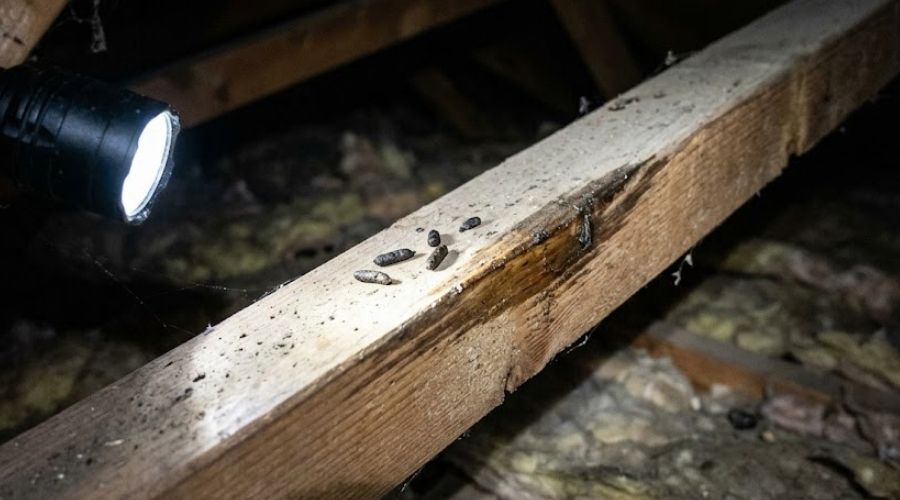
Roof rat attic infestations in Huntsville follow a predictable progression. A pair of roof rats enters through a roofline gap in late September or October as the hardwood canopy begins to thin. They establish a nesting site in the insulation. By December, the colony includes 8–12 animals. By February, if no intervention has occurred, it can exceed 30. The homeowner who acts on the first signs of activity in October deals with a far smaller remediation scope than the one who waits until February.
Here's what to look and listen for.
Sounds
The acoustic signature of a roof rat attic infestation is distinctive once you know what to listen for:
Scratching and scurrying at night
Roof rats are strictly nocturnal. Their primary activity window is 10PM to 3AM. Scratching, scurrying, and rolling sounds in the attic or ceiling during this window are the most common first alert homeowners notice. The sounds are usually intermittent — roof rats move in bursts, stop, and then resume. Continuous noise at the same location for several minutes suggests the animal is engaged in nesting activity or feeding.
The location of the sound within the ceiling helps identify the species. Sounds concentrated in the upper attic space overhead suggest roof rats. Sounds that seem to come from within walls, particularly at lower sections of walls near the floor, suggest house mice or Norway rats traveling in wall voids.
Gnawing sounds
Roof rats gnaw on wood framing, attic insulation backing, and electrical wiring insulation. The sound is a rapid, rhythmic chewing — different from the scratching of movement. Gnawing on electrical wiring is a documented fire risk; if you hear persistent gnawing in the attic or wall space near electrical runs, treat it as urgent.
Squeaking
Soft vocalizations — short squeaks — are most common during colony social activity and are more often heard during the early establishment of a new colony. A single squeaking sound is less diagnostic than the pattern of nocturnal movement described above.
Visual Evidence
If you're willing to open your attic hatch and look, the visual evidence of a roof rat infestation is unmistakable:
Droppings
Roof rat droppings are approximately 1/2 inch long with pointed ends at both ends — a spindle shape. They're found concentrated along rafter tops, on wall top plates, near entry points, and around nesting sites. Fresh droppings are dark and moist; older droppings are pale and dry. Concentrated deposits along a rafter indicate an established travel route — a runway the colony is using consistently.
Droppings quantity correlates roughly with colony size, though this isn't precise. A rafter with dense droppings along its full length has been used as a runway for weeks or months. A rafter with a few droppings has seen less recent activity.
Grease smears
Roof rats have oily fur that leaves a dark grease smear on surfaces they travel across regularly. These marks appear on the tops of rafters and top plates where the animal has traveled repeatedly — a visual map of the colony's highway system. Fresh smears are dark and greasy; older ones are dry and may have collected dust. Finding grease smears concentrated along a particular rafter indicates a primary travel route worth investigating further.
Nesting material
Roof rat nests are built in the insulation, typically near the eave corners where the sloped rafters meet the top plate — the most protected and thermally stable zone of the attic. The nests are constructed from shredded fiberglass insulation, paper, fabric, and plant material. They're dense, compact, and often larger than expected — a well-established nest can be 12–18 inches in diameter with distinct internal chambers.
Finding nesting material in the attic is confirmation of an established colony. A single animal exploring doesn't build a nest; nesting indicates the colony has committed to the space as a primary residence.
Damaged insulation
Roof rats shred the facing and backing of fiberglass batt insulation to create nesting material, leaving irregular voids and shredded areas that are distinct from the settled compression of old insulation. Tunnel-like depressions through the surface of blown insulation indicate travel routes through the insulation layer.
Roof rat vs. squirrel — how to tell the difference from sound alone
Squirrels in an attic are active at dawn and dusk — their activity corresponds to their outdoor foraging schedule, typically 6AM–9AM and 4PM–7PM. Roof rats are active 10PM–3AM. If you're hearing attic activity during daylight hours at dawn and dusk, suspect squirrels first. If the noise is reliably in the late-night window, suspect roof rats. Mixed infestations (both squirrels and roof rats) do occur in Huntsville's canopy-dense neighborhoods, but require an inspection to confirm.
Smell
A significant roof rat infestation in an attic space produces a musty, acrid odor that's a combination of urine, droppings, and the sebaceous secretions of the colony. This odor is typically first noticed in the rooms directly below the most active attic zones — master bedrooms, living rooms with cathedral or vaulted ceilings, and any room with ceiling penetrations (recessed lighting, HVAC registers) that allow attic air into the living space.
The smell alone is not diagnostic — it can also indicate moisture damage, wildlife other than rats, or attic mold. But a persistent musty odor in an upstairs room combined with nocturnal attic sounds is a strong signal for professional inspection.
When to Call
Any of the following warrants a call for a free inspection:
- Consistent nocturnal scratching or scurrying in the attic or ceiling
- Droppings found in the attic on a quick check with a flashlight
- Visible soffit or fascia damage at the roofline
- Tree limbs within 6 feet of your roofline (combined with any of the above)
- Persistent musty odor in upstairs rooms without another explanation
- Neighbors in Twickenham, Blossomwood, or Monte Sano reporting roof rat activity — infestations spread through the canopy network across adjacent properties
The free inspection takes 45–90 minutes and produces a confirmed species identification and entry-point mapping before any treatment is recommended. The earlier an attic infestation is caught, the smaller the remediation scope — catching it in October vs. February can be the difference between a straightforward removal and a full attic cleanup with insulation replacement.
Hearing Something in Your Attic at Night?
Free whole-property inspection across Huntsville and Madison County. Same-day available Mon-Sat 7AM-10PM.
📞 Call (844) 635-0403