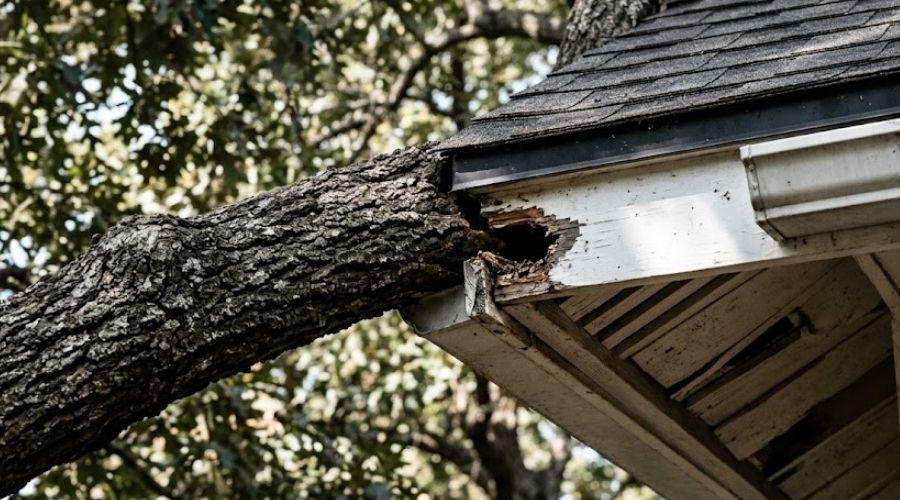
Roof rats (Rattus rattus) are exceptional climbers. They can scale vertical brick walls, traverse utility lines with the balance of a tightrope walker, and navigate dense hardwood canopy with the agility of a squirrel. In Huntsville, these capabilities translate directly into attic infestations in the city's canopy-dense historic neighborhoods — and understanding the specific pathway roof rats use to enter your attic is essential for blocking it.
Step 1 — The Canopy Delivery System
Huntsville's mature urban tree canopy is the roof rat's primary access network. In neighborhoods like Twickenham, Blossomwood, Five Points, and Monte Sano, the overhead hardwood coverage is dense enough that a roof rat can travel significant distances from tree to tree without ever touching the ground. This aerial network connects food sources, nesting trees, and residential rooflines in an unbroken pathway.
The key physical threshold is branch-to-roofline distance. Roof rats can jump approximately 4–6 feet horizontally. Any tree with branches growing within 6 feet of a roofline provides direct access. In Huntsville's oldest neighborhoods, where oaks and magnolias planted in the 19th century have developed massive spreading canopies, it's common to find multiple trees simultaneously touching or nearly touching a single roofline.
Utility lines are the secondary access route. Electrical service lines, cable television runs, and communication conduits that attach to the exterior wall of a home give roof rats a direct pathway from the adjacent utility pole — or from the tree the line runs through — to the point where the line enters the structure.
Step 2 — Roofline Survey
Once a roof rat reaches the roofline, it investigates systematically for entry points. Roof rats are neophobic — cautious about new environments — but persistent. An animal that reaches a roofline and finds it sealed will typically work the perimeter for several nights before abandoning the attempt. One that finds an opening will exploit it immediately.
The survey behavior produces predictable evidence: grease smears at the junctions where the animal has repeatedly traveled across roofline surfaces (fascia board tops, soffit panel edges), and small bite marks at the edges of materials being tested for weakness.
The Most Common Huntsville Attic Entry Points
Through thousands of inspections of Huntsville homes, certain entry point types appear consistently:
Open or deteriorated soffit panels
The soffit — the horizontal surface beneath the roof overhang — is the most common roof rat entry point in Huntsville's older housing stock. In postwar construction (1940s–1970s) throughout Blossomwood, Mountain Gap, and South Huntsville, original aluminum or wood soffit panels have buckled, separated at panel joints, or been damaged by weather and wildlife. Gaps at panel corners and joints are often 1–2 inches wide — well within the 1.5-inch minimum opening roof rats can exploit.
In historic construction (pre-1940) throughout Twickenham, the original wood soffit systems have experienced a century of expansion, contraction, and weathering. The gap development in these structures is more extensive and less uniform than in postwar construction.
Fascia board gaps at roofing junctions
Where the fascia board meets the roofing material at the top, gaps develop as the wood fascia shrinks through weathering and the roofing material settles. These gaps are typically at the roofline's upper edge — visible from the ground as a dark gap between the top of the fascia and the first course of roofing. Roof rats investigate this junction routinely because it's at eye level when they travel along the top of the fascia board.
Attic ventilation screen failures
Gable-end vents, ridge vents, and eave soffit vents provide necessary attic air circulation. The screening that keeps wildlife out of these vents — typically aluminum mesh — corrodes, gets damaged by impact, or is simply absent on older Huntsville homes that were never properly screened. A 1.5-inch gap in a gable vent screen is sufficient roof rat entry.
Ridge vents on newer construction deserve particular attention: continuous ridge vent systems on 1990s–2010s homes in Hampton Cove and Providence use a flexible plastic material that degrades in Alabama's UV intensity, developing cracks and gaps that weren't present at original installation.
Plumbing stack and roof penetration gaps
Where plumbing vent stacks exit through the roof, the flashing junction between the stack pipe and the surrounding roofing material develops gaps as the roofing ages and the flashing weathers. A gap of 1 inch around a 3-inch stack pipe is 4+ inches of circumference — sufficient for roof rat entry. These gaps are invisible from the ground and only discoverable from the roof surface or the attic interior.
Utility line entries
Where electrical service, cable, or communication lines enter the attic through the soffit or exterior wall, the penetration opening is frequently larger than the cable itself — particularly in older construction where cable has been added or upgraded over decades without sealing the previous entry gap. These penetrations are often at the soffit-to-wall junction, exactly where roof rats are traveling when they reach the roofline.
Why sealing one entry point isn't enough
A roof rat that finds its primary entry point sealed will investigate the surrounding roofline for the next available opening. In a typical Huntsville home with aging roofline components, there are often 3–8 viable secondary entry points within a few feet of any sealed primary entry. Closing one while leaving the others open relocates the entry point rather than blocking access.
What Happens Once They're In
Roof rats that gain attic access typically establish nesting sites within days. They prefer the deepest sections of the attic insulation near the eaves — warm, protected, and away from the attic access hatch. Nesting material is assembled from shredded insulation, fabric, and plant material. A single nesting chamber in fiberglass batt insulation can be 12–18 inches in diameter.
From the attic, roof rats extend their activity into wall voids (traveling down wall cavities behind electrical outlets and switch plates), into soffit spaces between floors of two-story homes, and occasionally into kitchen and utility spaces where wall voids provide access behind appliances.
The longer an attic infestation goes unaddressed, the more extensive the contamination and structural damage. Insulation soaked with rat urine and saturated with droppings throughout a full attic space is a remediation scenario that costs significantly more than the same infestation caught early. The scratching noise at night is not a reason to wait — it's a reason to act.
Scratching in Your Attic at Night?
Free attic and roofline inspection across Huntsville and Madison County. We identify the entry points before recommending anything.
📞 Call (844) 635-0403