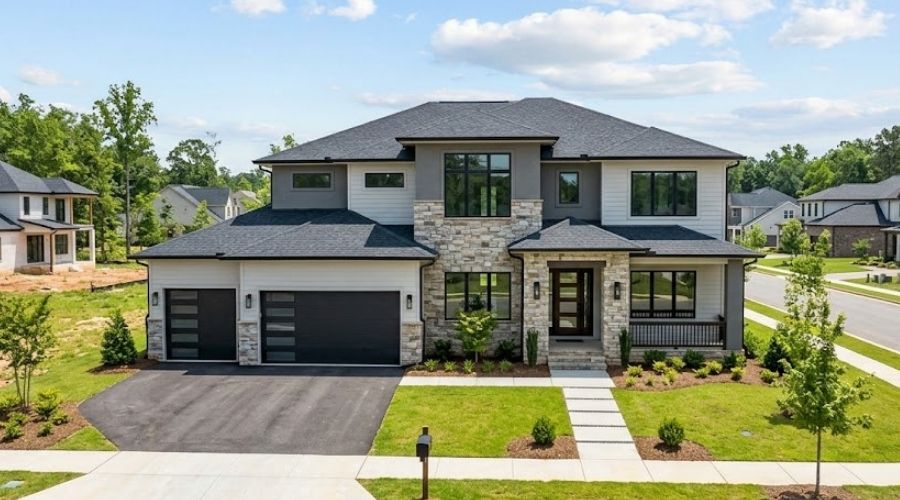
Huntsville's rapid residential growth in communities like Hampton Cove, Providence, Harvest, Meridianville, and the developing subdivisions along the I-565 and US-72 corridors has put a large number of 2000s–2020s homes into the market. Buyers and owners of these properties often assume that newer construction means better protection against rodents — tighter framing, better materials, more recent weatherproofing. The assumption isn't unreasonable. It's also wrong.
Newer construction creates different rodent vulnerabilities than older construction, not fewer. And in Huntsville's year-round rodent-pressure environment, house mice find those vulnerabilities within months of original construction.
Why New Construction Has Mouse Problems
Factory-cut framing gaps
Modern wood framing in production homebuilding is cut to dimension at the factory and assembled on-site. The framing members are accurate, but the assembled wall system has consistent gaps at the sill plate — the bottom horizontal member of the wall framing that rests on the foundation — where the framing meets the foundation or slab. These gaps are designed into the system to accommodate tolerances in the concrete work; they're not construction defects. They're also not sealed in the field, because the standard practice is to rely on the interior floor covering and exterior weather barrier to close them.
Neither of those closing elements fully seals against mouse entry. The result is a 1/4 inch to 3/4 inch gap running along the full perimeter of the slab at the sill plate — a continuous mouse-width opening that's present in virtually every production-built Huntsville home from the past 30 years.
Unsealed utility penetrations
Where HVAC refrigerant lines enter the home through the exterior wall, where plumbing supply and drain lines exit through the slab or exterior wall, where electrical conduit enters from the service panel — all of these penetrations are made during rough-in and the gaps around the pipes and conduit are nominally sealed with foam or caulk during finish. In production homebuilding, this sealing is often incomplete or inconsistent: foam that doesn't fully contact the pipe surface, caulk that was applied to a dusty surface and didn't adhere properly, or penetrations that were simply skipped in the finish work.
Mice in the utility room, server room, or behind the refrigerator often entered through these penetrations — sometimes years after original construction, as the foam cured, shrank, and pulled away from the pipe surface.
Garage door weather stripping degradation
The single most common mouse entry point in Hampton Cove, Harvest, and Meridianville homes is the garage door weather stripping corner. The bottom seal on a garage door contacts the floor surface along its full width, but the corner where the bottom seal meets the side seal has a structural gap — a point where two separate weatherstripping components meet and can't form a continuous contact seal. This gap is typically 1/2 to 1 inch in the corner, and it appears in new construction immediately because it's a design feature of the door system rather than a degradation problem.
As the garage door bottom seal ages and softens — typically after 5–10 years — the corner gap widens. A garage door system that was barely-adequate at original installation becomes a significant mouse entry point 7 years later as the seal material loses its resilience.
Landscape settlement creates new entry points
In the first 3–7 years after construction, the landscaping around a new Huntsville home settles, plants and trees mature, and the grade around the foundation shifts slightly as the soil compresses. This settlement process frequently opens gaps at the foundation perimeter that weren't present at move-in: gaps at the sill plate junction as the foundation settles relative to the framing, gaps where landscape timbers pull away from the foundation, and gaps at the termination of the exterior weather barrier where it contacts the foundation.
These post-settlement gaps are why many Hampton Cove and Providence homeowners who had no mouse problems in years 1–3 after moving in suddenly encounter them in years 5–8. The house didn't change; the surrounding interface between the house and the landscape did.
Roof Rat Pressure in Newer Huntsville Developments
House mice are the dominant rodent issue in most newer Huntsville residential development, but roof rat pressure is emerging in areas where the landscaping has matured. Hampton Cove's proximity to Monte Sano State Park means that lots on the development's eastern edge — those adjacent to the wooded greenways and natural buffers connecting to the park — face roof rat pressure that grows as the landscaping planted at construction reaches roofline height.
A Hampton Cove home with mature trees overhanging the roofline in 2026 is presenting conditions that weren't present in 2015 when the home was built. The roof rat pressure follows the tree growth.
The 5–10 year inflection point in newer Huntsville homes
The most common pattern we see in Huntsville's newer suburban communities: homeowners who had no rodent issues for the first several years in their new home call us in year 5–10 as original construction materials degrade and landscaping matures. The entry points were always there; they've just reached the point where they're permeable enough for mice to use consistently. Catching this at the 5-year mark with a proofing inspection is far less expensive than dealing with an established infestation at the 10-year mark.
What to Do
If you're in a newer Huntsville suburban home and experiencing your first mouse encounter, the first step is a free inspection that documents all current entry points. We assess the sill plate gaps, utility penetrations, garage door corner condition, and roofline (for homes on Hampton Cove's park-adjacent lots) and give you a written quote for sealing before the activity becomes an established infestation.
For homeowners in newer development who haven't yet had a rodent problem but want to get ahead of it: a preventive proofing inspection — identifying and sealing the factory-cut gaps and utility penetration openings before mice find them — is consistently more cost-effective than addressing an established infestation later. Call to schedule at any point; Mon–Sat, 7AM–10PM.
Mouse Problem in Your Newer Huntsville Home?
Free inspection for Hampton Cove, Providence, Harvest, Meridianville, and all Madison County suburban communities.
📞 Call (844) 635-0403