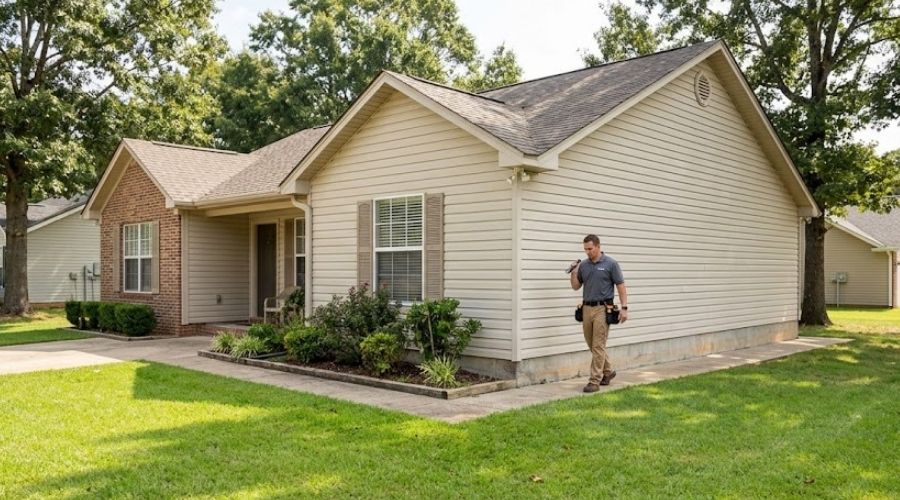
Rat proofing is not a single repair or a one-afternoon project. It's a systematic survey of every gap in a home's exterior envelope larger than 1.5 inches (the minimum size a Norway rat can exploit) followed by the installation of materials that resist a rat's physical strength and gnawing capability. Done correctly, it makes a completed removal permanent. Done incompletely, it provides the illusion of protection while leaving the actual pathways open.
This guide covers every significant entry point type found in Huntsville homes, the materials appropriate for each, and the differences in approach required by the city's diverse construction eras.
Why Rat Proofing Is Different From Mouse Proofing
House mice can enter through gaps as small as 1/4 inch — roughly a pencil eraser's diameter. Rats require a minimum of approximately 1.5 inches for Norway rats and slightly less for the slimmer roof rat, though roof rats can compress through surprisingly small openings when the opening is positioned at a point on their regular travel route.
The material standards differ accordingly. For mouse-sized gaps (1/4 to 3/4 inch), steel wool backed with caulk is effective — mice won't chew through steel wool. For rat-sized gaps (1.5 inches and larger), steel wool is not adequate — rats have the jaw strength and persistence to chew through it. Rat-sized gaps require hardware cloth (a minimum of 1/2 inch galvanized or stainless steel mesh), concrete mortar for masonry openings, or sheet metal plate for gaps in wood framing. Foam sealant alone is never adequate for rat-sized openings.
Entry Points by Zone — Roof Rats
Soffit and fascia system
The soffit (the horizontal surface under the roof overhang) and fascia (the vertical board behind the gutter) are the primary roof rat entry zone in Huntsville homes. Entry occurs at:
- Gaps at soffit panel joints and corners, particularly in aluminum soffit systems where panels have buckled or separated
- The junction where the top of the fascia meets the underside of the roof decking or first course of shingles
- Any location where a soffit panel is damaged, missing, or has been improperly patched
Sealing approach: Stainless steel mesh fastened to the structural member behind the gap, with caulk backing at the mesh-to-material junction. For larger open soffit sections where the panel is missing, replacement with solid soffit material is preferable to hardware cloth, which can be progressively chewed at its edges over time.
Attic ventilation
Gable vents, ridge vents, and eave soffit vents all require intact screening. The appropriate mesh for rat exclusion at ventilation openings is 1/2 inch hardware cloth (not window screen, which tears easily).
Sealing approach: Overlay existing deteriorated screen with 1/2 inch hardware cloth secured with screws around the vent perimeter. For fully deteriorated screens, remove the existing material and install new hardware cloth before replacing the vent cover.
Plumbing stacks and roof penetrations
Where plumbing vent stacks exit through the roof, the gap between the pipe and the surrounding flashing is a consistent roof rat entry point on older Huntsville homes.
Sealing approach: Hardware cloth collar — a formed piece of 1/4 inch hardware cloth shaped to fit around the pipe and lap onto the surrounding roof surface, caulked at both the pipe contact and the roof contact. This maintains proper flashing function while closing the entry gap.
Entry Points by Zone — Norway Rats
Crawl space vents
Original crawl space ventilation screens on pre-1980 Huntsville construction are typically galvanized metal mesh that has corroded to the point of significant degradation. Norway rats push through these screens without difficulty on many older properties.
Sealing approach: Replace or overlay with 1/4 inch hardware cloth (galvanized or stainless, 16 gauge minimum). Stainless is preferred in south-facing or high-moisture crawl space environments where galvanized corrodes more rapidly. Hardware cloth replacement should be secured to the vent frame with screws at 3–4 inch intervals, not just staples, which rats can pull away from wood under sustained pressure.
Foundation-level utility penetrations
Where plumbing drains, gas lines, electrical conduit, and HVAC lines enter through the foundation wall or slab, the gap around the penetration is often the original construction gap — never sealed at original build. These are consistent Norway rat entry points in Huntsville's older construction.
Sealing approach: Expanding foam with 1/4 inch hardware cloth embedded in the foam before it cures. The foam seals the gap; the hardware cloth prevents the foam from being chewed through. For penetrations in masonry foundations, hydraulic cement around the pipe is more durable than foam.
Crawl space access doors
Crawl space access hatches — both exterior and interior — often have gaps at corners and along door edges where the door has settled away from its frame. Gaps of 1/2 inch or larger allow Norway rat entry.
Sealing approach: Door sweep on the bottom edge; foam backer rod caulked at the frame contact on all sides; hardware cloth reinforcement on the door face if the door material is thin wood or composite that rats could chew through.
Entry Points by Zone — Both Species
Garage door weather stripping
Garage door bottom seals and side weather stripping fail at the corners — the point where the vertical side seal meets the horizontal bottom seal. This corner gap is the most common mouse entry point in Huntsville suburban homes and provides access for rats in properties where the surrounding pressure is rat rather than mouse.
Sealing approach: Full weather stripping replacement, not just the bottom seal. The side seals and the astragal (the seal between double doors) must be evaluated and replaced together for a complete seal. Corner gaps specifically should be addressed with foam backer rod before weather stripping replacement to fill the frame gap that the stripping alone can't fully seal.
Exterior door sweeps
Exterior doors, utility room doors, and garage-to-house doors without functional door sweeps leave a ground-level gap along the full door width. Norway rats and mice travel through these gaps routinely.
Sealing approach: Automatic door bottom (preferred — maintains contact with the floor as the door swings) or brush-type door sweep for doors over uneven thresholds. Standard aluminum door sweeps with rubber blades are adequate when the door-to-threshold contact is uniform and the blade is new.
Brick weep holes
Weep holes — the small openings in the lower course of exterior brick — are intentional drainage features. They're also exactly mouse width (approximately 3/8 inch). Rats don't enter through standard weep holes, but they can exploit weep holes that have been enlarged by damage or original installation variation.
Sealing approach: Copper mesh inserts — a pre-formed copper mesh plug that fits into the weep hole opening, maintaining the drainage function while blocking animal entry. Never seal weep holes solid with caulk or foam — they're a critical moisture management feature.
The DIY limitation
The challenge with DIY rat proofing isn't the sealing technique — most of the methods above are accessible to a motivated homeowner. The challenge is the inspection: finding every significant entry point before beginning to seal. A typical Huntsville home has 15–40 potential entry points. Sealing the obvious ones while missing a third of them produces a result that doesn't hold. The professional value is primarily in the systematic inspection that precedes the sealing — we find the gaps that aren't visible without specific access and equipment.
Construction-Era Differences in Huntsville
Rat proofing approach differs significantly by construction era in Huntsville:
- Pre-1940 (Twickenham, Merrimack): Heritage-sensitive materials required. Copper mesh rather than galvanized at brick contact points. Lime mortar-compatible sealants at masonry gaps. Hardware cloth attachment methods that don't damage original wood. More extensive inspection time due to century-plus of gap development.
- 1940s–1970s (Blossomwood, Terry Heights, South Huntsville): Crawl space vent replacement is priority one. Original aluminum soffit systems have typically failed at multiple panel joints. Attic ventilation screen replacement usually needed throughout.
- 1980s–2000s (Rolling Hills, Sherwood Park, Hampton Cove): Focus on garage door weather stripping, brick weep holes, and HVAC line caulk at exterior walls. Crawl space less common; slab foundation homes have different entry point profile.
- 2000s–present (Providence, newer Hampton Cove): Sill plate gaps from factory framing, garage door corners, and HVAC slab penetrations are the primary targets. Crawl space pressure is uncommon. Roof rat pressure is emerging as landscaping matures to roofline contact.
When to Do Rat Proofing
The ideal timing for rat proofing is immediately following a completed active removal — before the surrounding population repressures the property. Proofing while an active colony is still present risks sealing animals inside the structure, creating odor problems and driving gnawing pressure on sealed gaps from the interior.
Rat proofing can also be done as standalone prevention on properties without a current active infestation. If your neighborhood has active roof rat pressure (Twickenham, Blossomwood, Monte Sano), if your property has tree limbs within 6 feet of the roofline, or if you've had a prior infestation that was treated without exclusion — proofing before the next infestation establishes is far more cost-effective than waiting to treat and remediate.
Ready to Proof Your Huntsville Home?
Free whole-property inspection and written quote before any work begins. Mon-Sat 7AM-10PM.
📞 Call (844) 635-0403